English to Spanish Its Never Happening Again
I love to share my extensive gardening knowledge with readers so that they, too, can savour the wonders of all kinds of verdant plant life.
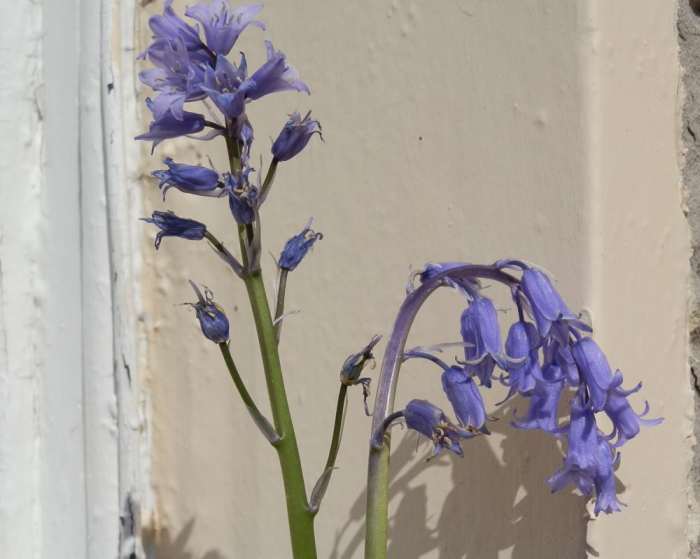
The upright Spanish bluebell on the left, and the drooping English bluebell on the right (although the English bluebell is showing signs of having crossed with the other).
self
Spanish X and Wild English Bluebells
I had to stare hard at these two photos higher up for quite a while to notice the divergence between the 2 plants.
The plant on the left comes from my garden, while the plants on the right comes from a woodland bluebell grove nestled deep in the countryside, miles from the madding crowd.
The principal differences between a Castilian bluebell and an English bluebell are:
- On the Spanish flower, the bells are all around the stalk, not simply on one side, which gives the English language bluebell its drooping stature.
- The leaves are wider and bigger.
- The petals of each bell open wider and flare at the ends rather than gyre.
- The bells are slimmer on the English bluebell.
- The stamen is blue on the Spanish version and yellow on the English i.
- The English bluebell is a deeper blueish than the Castilian one, which is a frail shade of pale blue.
- The English bluebell is stronger scented.
- The Spanish bluebell is taller.
- The Spanish bluebell tin tolerate sunshine and happily grows in open spaces, whereas the English language bluebell prefers at least partial shade and is never found growing in open spaces.
- Castilian bluebell flowers lift their heads towards the lord's day. English language bluebells never practise.
Many gardens accept a Spanish and English bluebell cross, which has some of the characteristics of each plant.
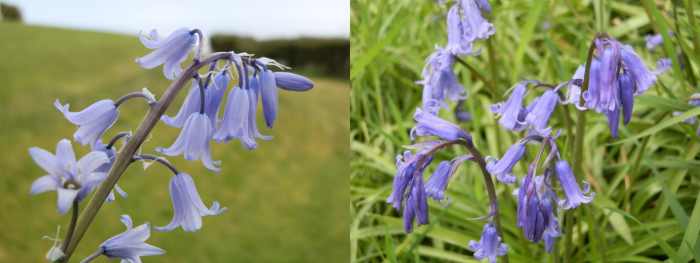
Spanish/English bluebell cantankerous on the left, and a woodland pure bluebell on the right.
self
Hyacinthoides Non-scripta
The traditional, mutual bluebell, Hyacinthoides non-scripta, is a perennial spring wildflower common in Europe from northern Spain upwards.
The whole of the British Isles and Republic of ireland were in one case carpeted with them, when the lands were mostly forest, which is where the wild bluebell grows.
While it is often referred to as the "English bluebell," this nickname appears to be a recent development, as people used to refer to these flowers as "bluebells" or occasionally, "wild hyacinth".
The wild bluebell grows in wooded areas in shade or dappled sunshine, and it flowers for about a month in early bound each year.
They make wonderful cut flowers for the house, and their heady scent pervades the air, bringing the promise of summer.
The common bluebell has naturalized in many parts of the Usa, where it is an introduced species.
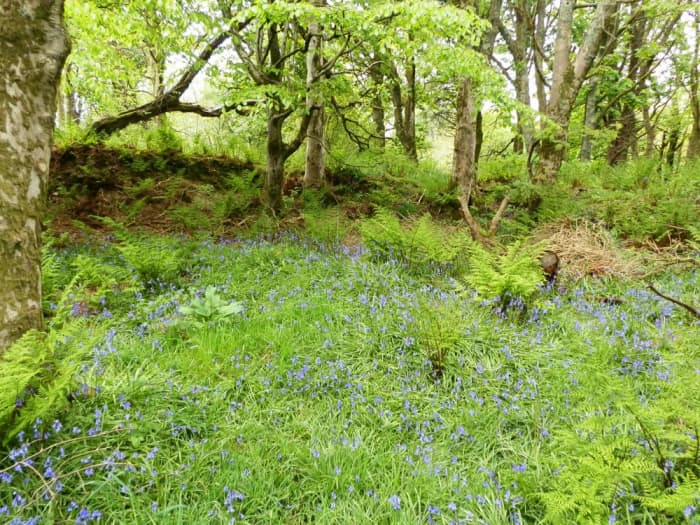
Bluebell wood.
self
Hyacinthoides hispanica
The Spanish bluebell was introduced into British gardens in the 17th century, and then information technology is hardly a newcomer.
Scroll to Continue
Read More From Dengarden
Upright, erect, colorful and with the ability to grow in total dominicus, the Spanish bluebell really makes a much amend garden bloom.
My garden is full of bluebells, Spanish, English and the SP/Eastward cross, which are chosen Hyacinthoides massartiana, which is too much like "Martian" for my liking. They are NOT aliens; they are beautiful garden flowers that have some cross-breeding in their otherwise pure background.
In effect, they are multicultural bluebells.
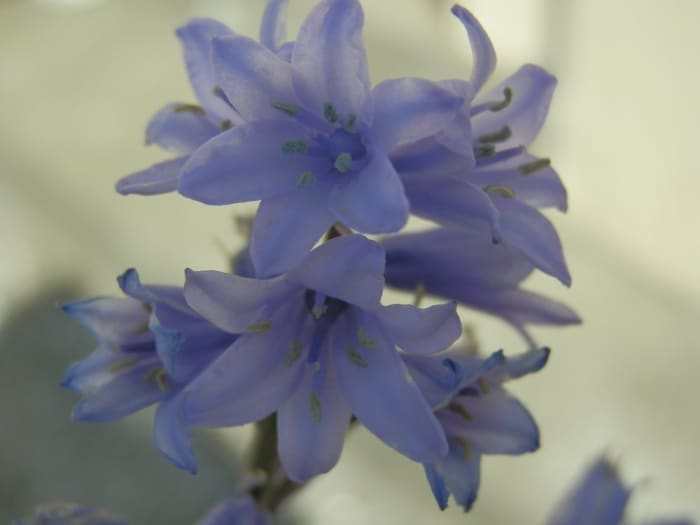
A close-upwards of Spanish bluebells.
cocky
How to Propagate Bluebells
Nature does an splendid task of propagating bluebells. Each flowerhead, and in that location are literally millions in a dumbo bluebell wood, is packed with black seeds encased within the dried sacs at the base of the flowerhead.
When they are ripe, the sacs open and cast the seeds to the wind or to the wood floor underneath.
There, many seeds germinate and sprout the following year equally a slender grass-like leaf. At the base forms a tiny bulb which gets bigger every year until it too is mature enough to flower.
Other seeds become food for small forest foraging birds and animals, but those who survive very quickly help spread the new colony of bluebells.
Meanwhile, each flowering plant sends out bulblets underground, which flower when they mature. In this way, 1 single bulb can very chop-chop colonize a large area, given the perfect growing conditions.
The wild bluebell prefers the acidic but enriched soils found in woods floors.
To grow bluebells, y'all will need either seed or bulbs; there is no other way to grow them.
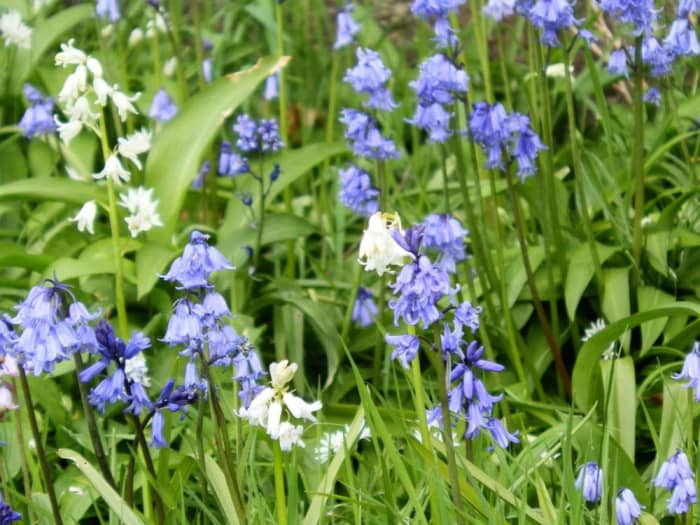
Spanish bluebells in the wild.
self
How Bluebells Cross With Each Other
Wind or insects carry the pollen from one flower or found to another.
While the English language bluebell will always remain and so, and the adjunct bulbs the main bulb throws off each will also continue to be pure bluebells, the seeds that develop on the bloom heads each year will deport the parentage of the pollen that arrived on the carpel, the female office of the flower.
The resulting seeds will grow into a hybrid cross should that pollen come up from a Spanish bluebell.
Because the Spanish bluebell is the more dominant species, the resulting flowers will prove more than likeness to their Spanish parent than they practice to their English language parent.
Scientists are worried that eventually the English language bluebell volition dice out, equally its characteristics are slowly lost.
Each bulb reproduces to grow several more clones each yr, and the new bulbs can flower in a much shorter time-scale than their seedling brothers.
So, in upshot, having a collection of pure English language bluebell bulbs placed, or growing, in a protected expanse will ensure the continuation of the species.
Equally bluebells grow best in deep forests, under the awning of trees, and every bit deforestation continues, then it is possible that one day there will be no English bluebells left except in laboratories.
But that is not nigh to happen in our lifetime, so we may as well just bask those pretty flowers as they are, whether they are Castilian or English.
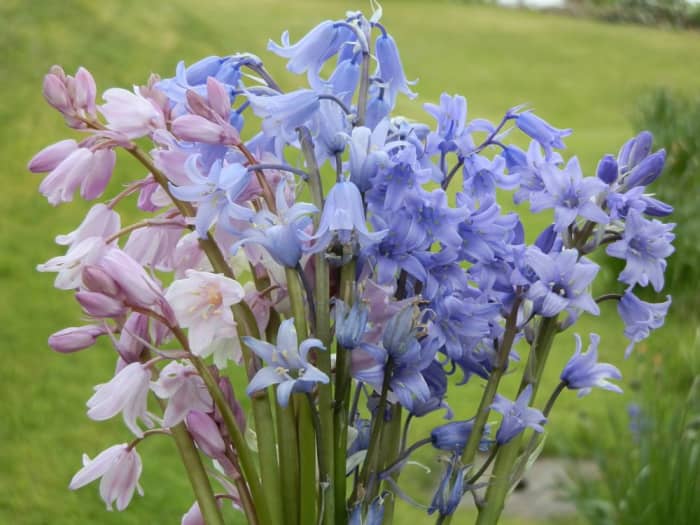
A bunch of garden bluebells.
self
Meep on May 16, 2020:
Im doing a projection on these very usefull this site was!
Jo Parker on April 24, 2020:
I am very pleased that our government fabricated it illegal to choice or uproot bluebells as otherwise some areas could take been severely depleted. I doubt that this had whatever impact on fiscal or criminal activities.
CB on May 09, 2019:
Thoroughly enjoyed this commodity! I found information technology an informative & fun read. As I am contemplating adding bluebells to our garden, this was a expert primer. Give thanks you.
Roger Griffith on May 03, 2019:
This author has more opinions than noesis
Slioch on May 01, 2019:
"Y'all'd be forgiven for thinking that Armageddon had arrived, all because the Spanish bluebells were intermingling with English bluebells, and were COMING OUT ON Pinnacle!
Like, does information technology matter?"
What a greatly ignorant comment. The sort of comment that could simply come up from someone cynical of history and heritage, non to mention ecology. Or perhaps someone blinded past the money that garden centres and nurseries can make by selling damaging plants to devil-may-care shoppers.
Rather like those who don't give a damn about our native red squirrels being displaced and killed by Due north American greys.
Anita on Apr 24, 2019:
What can I do if a garden center has sold me Spanish bluebells as English bluebells? I want the truthful woodland bluebell. This has happened twice.
Valerie Weir on April 23, 2019:
I am a Scot and take e'er lived in country areas in Scotland. Everybody I knew chosen harebells, bluebells . This is the Scotch Bluebell. We learned at school that the 'proper' name for them was harebell.
We chosen Hyacinthoides non-scripta, wild hyacinths and learned that these were chosen bluebells in England.
Sally Tough on April 23, 2019:
My husband from the West declension of Scotland always calls bluebells, harebells.
Confusing for me as I'm English!
How rare are white native bluebells?
Sally Tough on April 23, 2019:
My Scottish highlander husband calls them harebells!
How rare are the white native bluebells?
Tom Mc~~ on March 28, 2019:
My male parent was Irish (Bn.1920s) and he always chosen our harebell a bluebell .
Sue on Feb 02, 2018:
Cheers for this very informative post, not bad info on the two kinds of Bluebells.
bazcoleman on May 07, 2014:
English, Spanish or Hybrid. That's what happens. That's evolution happening correct now. My English son has married a lovely Spanish girl and their daughter, Carlotta, is a beautiful hybrid. What does information technology matter if the bluebells mix? Equally long as in that location are bluebells in the Spanish and in the English springtimes I will be happy.
GardenExpert999 (author) from Scotland on June 03, 2012:
It's a good way to tell the difference for anyone wondering, as the wild bluebell's stamen is always yellowish, and harder to see as y'all have to prise the petals apart.
Leah Lefler from Western New York on June 02, 2012:
We saw several bluebell forest in Ireland when we lived at that place- they are so beautiful! I didn't realize the Spanish Bluebells were a different type - interesting that the stamen is blue!
Source: https://dengarden.com/gardening/The-Difference-Between-Spanish-and-English-Bluebells
0 Response to "English to Spanish Its Never Happening Again"
Post a Comment